#36 Deeper Into Outer Space | Dorothy’s Acid House Blueprint
Scouse mappers of nightlife history Dorothy share how they have celebrated club culture in their designs including the iconic Acid House Blueprint…

Despite the current abundance of dance music books, articles, Substacks (sorry-not-sorry) and online content we’re wading through, there are still stories waiting to be told around forgotten or overlooked scenes.
While written narratives are increasingly rife as DJs, journos (including myself) and rave veterans fall over themselves to show off the battle scars of forgotten nights and parties, Liverpool-based design agency Dorothy is creating its own visual representation of electronic music culture with its Blueprints series.
These are ingenious maps and t-shirts of scenes and sounds pinned to a 303 or circuit diagram of a Klipschorn speaker, celebrating disco, electronic music and beyond. When I was writing ‘Out of Space’ in our Liverpool gaff during 2021, I always thought Dorothy would be amazing to feature due to how they’ve explored this relationship between club scenes and the environments surrounding them.
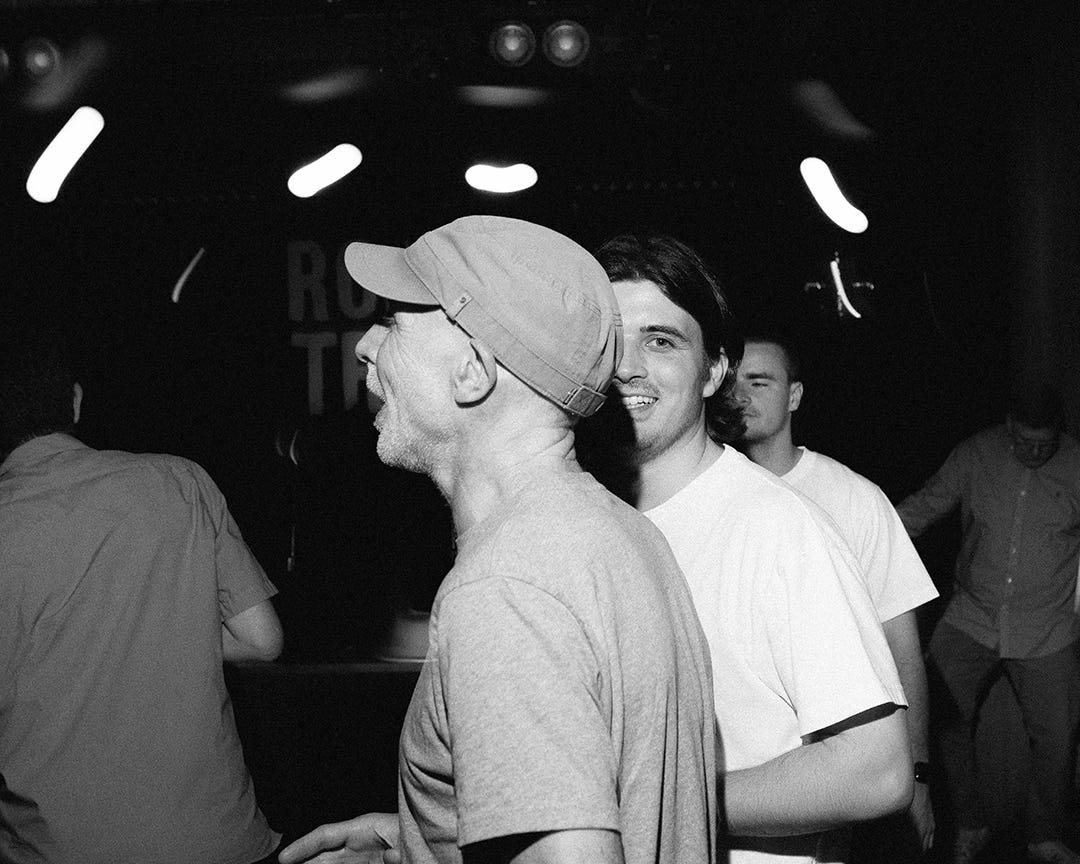
After joining Dorothy for their Q&A with DJ History’s Bill Brewster and Frank Broughton on a hot July night at Rough Trade Liverpool earlier this year, they recently announced a new, third version of their Acid House Blueprint. It seemed like a no-brainer to quiz them about the process of putting this together.
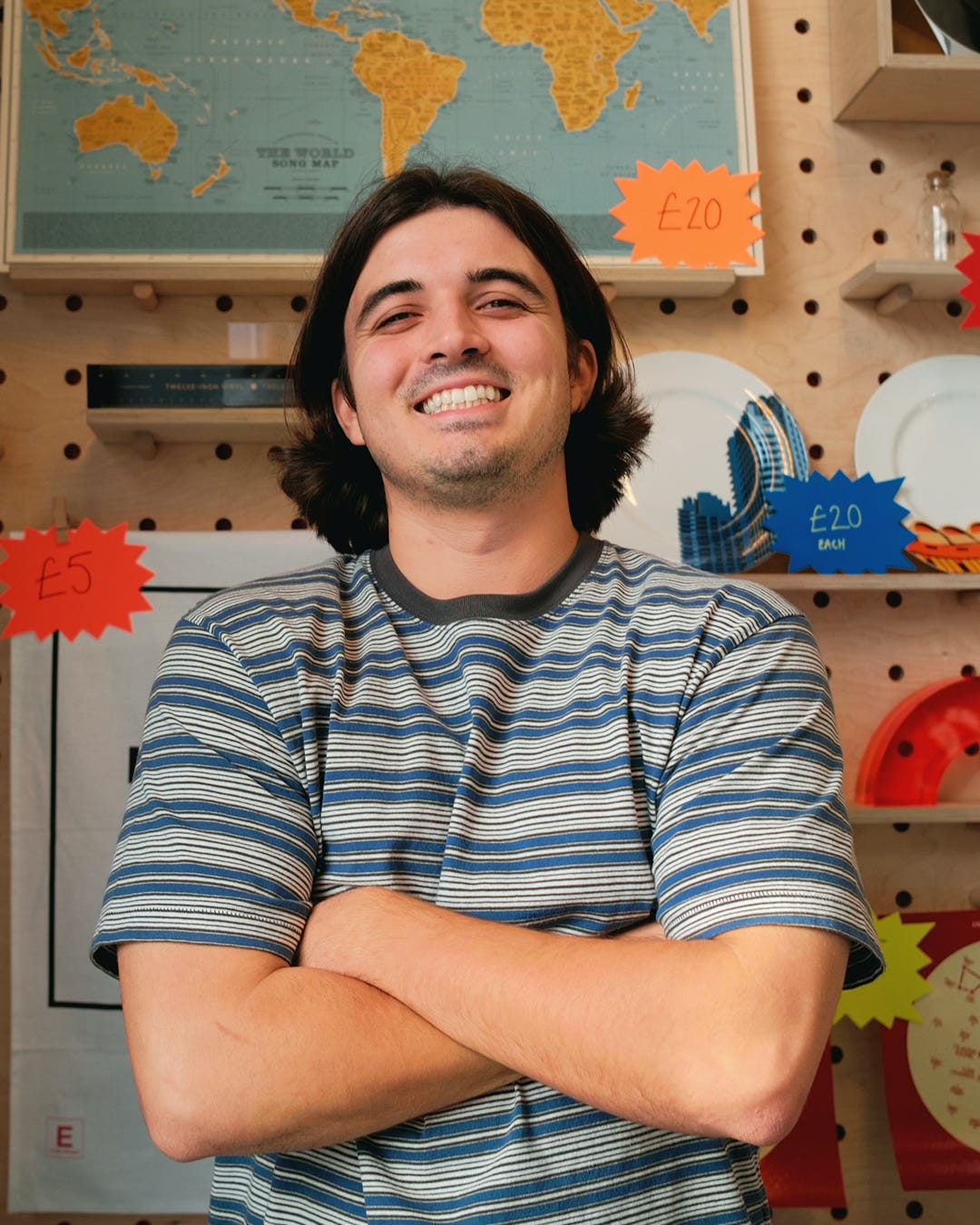
Here, Dorothy’s Ian Mitchell and Sonny Mitchell Johnson discuss their creative vision, clubbing experiences and some of the highlights from this latest version of the Acid House Blueprint.
Congrats on the new edition of the Acid House Blueprint! How has it evolved?
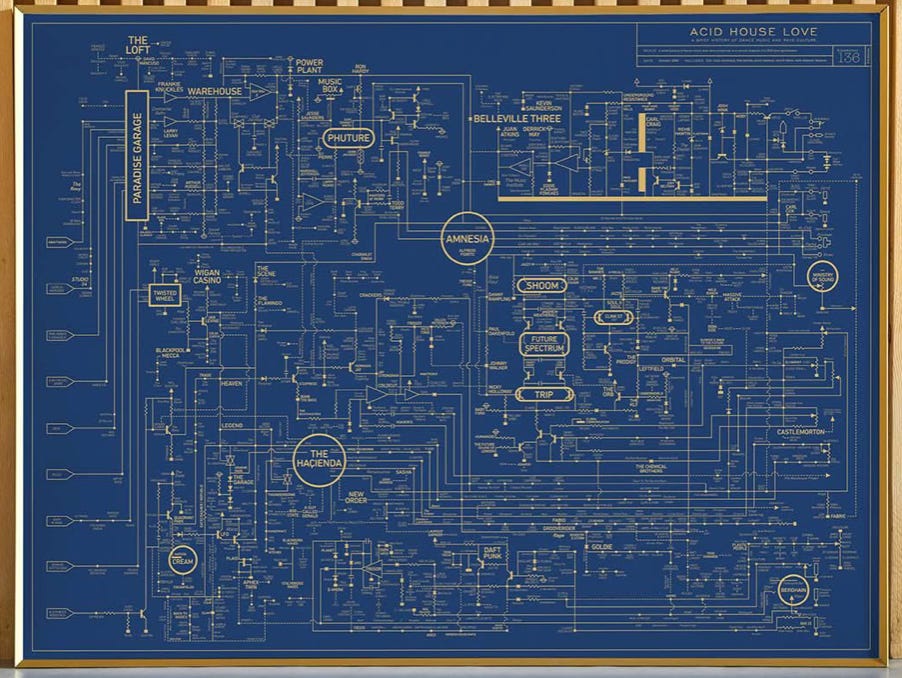
Ian: Well the first edition was done back in 2018, to coincide with the 30th anniversary of the Second Summer of Love. We produced a second edition a couple of years later (during lockdown I think) to amend a few minor errors and take the opportunity to add some new names, represent female DJs more fully and emphasise some of the legends that had sadly passed away.
Since then I’ve continued to research the history of dance culture, partly because I just enjoy it, but also because I was developing more prints for Dorothy – one about the Blackburn free parties in ‘89 and ‘90, a blueprint for Liverpool Museum just about the Liverpool scene, one for We Out Here festival and a full on Disco Love Blueprint. To me it was clear that there was scope for a major update to the Acid House Blueprint.
Where did the idea for the original version come from?
Ian: I’d watched the success of the early blueprints Dorothy had produced and suggested that they should do one for acid house to coincide with the 30th anniversary of the Second Summer of Love. I had a fair knowledge of dance culture history and felt with a bit more research I could provide Dorothy’s Jim (Quail) with enough information for him to design it.
“The idea developed from just celebrating acid house to mapping the history of dance culture more broadly. We found a diagram of the Roland 303 circuit board and Jim went to town mapping my research onto it.”
I’m interested in the research process when putting this together? How have you approached this and the other mapping projects? It must be a fairly painstaking process?
Ian: The first version was put together quite intuitively. As I said I had a good knowledge of the basic narrative, I had some lived experience from ‘87 onwards, and a fair to middling record collection. I filled in the gaps by reading the handful of books that were available back then, and then cross-checked them with what was now getting documented online.
Jim did an amazing job translating my mind maps and lists into the blueprint, needing to do his own research to understand the connections and significance of individuals. I think the process took about eight or nine months in total – which was quite quick. Other blueprints can take much longer depending on the amount of research that’s required. They definitely become labours of love.
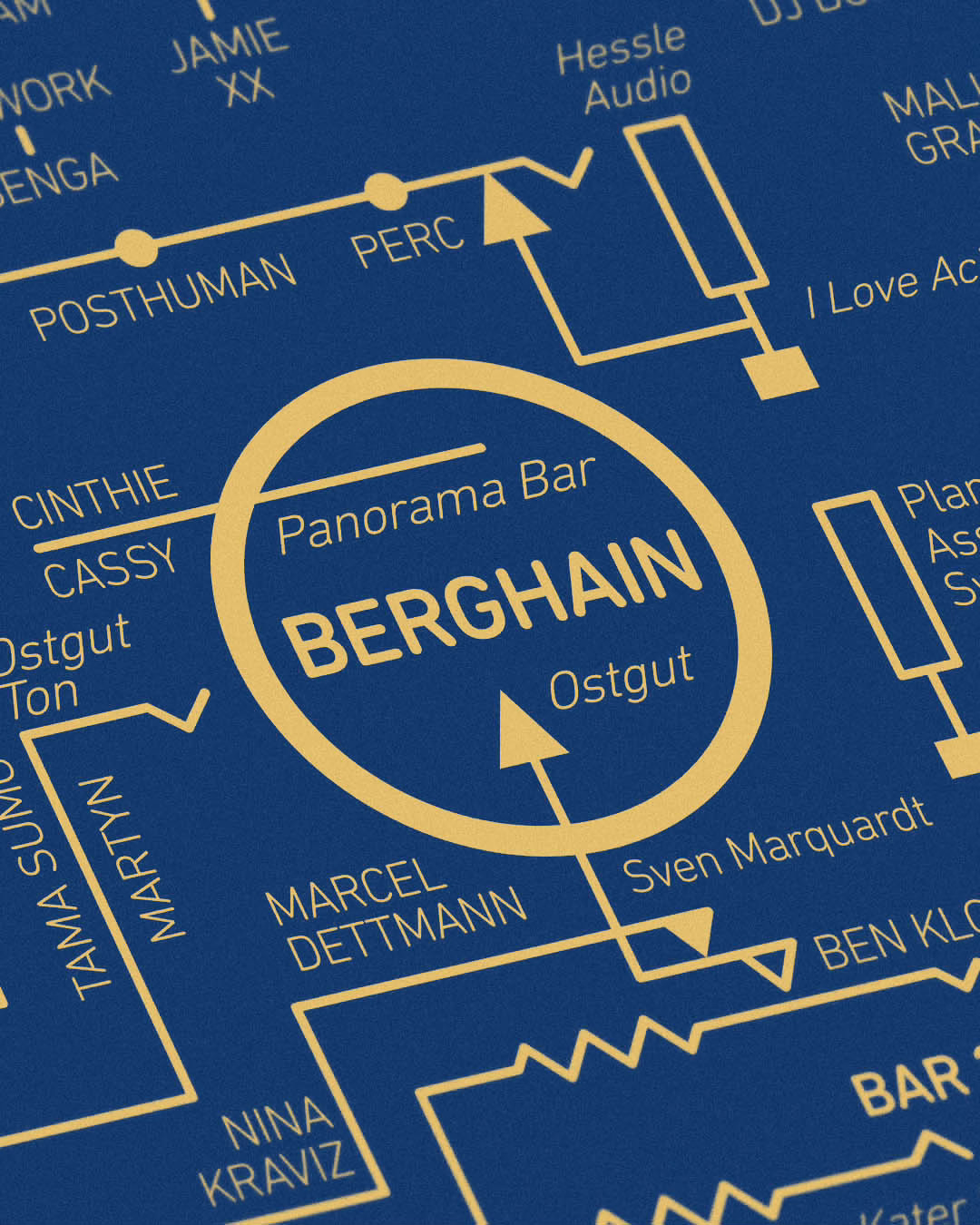
Since then I’ve become more conscious of how the blueprints are put together. In my role as a Graphic Design Lecturer I’ve looked at the process within the framework of field theory and entangled history. Field theory is useful to understand the underlying logic of mapping the content across the blueprint. For instance, the Acid House Blueprint uses a very fuzzy diagonal axis. A timeline running from disco (top left) to Berghain (bottom right). The Disco Blueprint uses a two-axis concept. A horizontal timeline going from real instrumentation to electronic and digital and a vertical axis with “the club” or underground at the bottom and “pop” or overground at the top.
Obviously, this is just a framework and there are lots of exceptions to the rule – but it helps in the transition from research to design. Just as the underlying circuit board diagram does too. Strangely each circuit diagram suggests certain ways to map the information.
“Entanglement is a term that describes an approach to history where everything is considered connected, culture is hybrid and reciprocal, and where everything is influenced by everything else. This seemed to sum up what we try to do with these blueprints nicely. It’s an idea that also acknowledges the lesser known and more marginalised stories and their significance to the history.”
Although the grand narrative of dance culture is presented on the print through the scale and placement of the clubs and artists associated with the culture’s creation myths, we were keen to flatten out this narrative as much as possible by foregrounding some lesser known but equally important moments (the Hedonism section for instance) and very niche, often personal micro stories.
This seems to have really resonated with the dance music community. People are very grateful for being included – almost surprised. We’ve embraced this idea with the latest edition. There’s so much more history documented and easily accessible now, whether that’s books such as yours or those by Matt Anniss or Emma Warren, or the never-ending stream of online articles. Just to restate, the research process is very much read, read, and read. Take notes, listen to the music, make lists, cross-check online (Discogs has become a key resource) and try not to get sidetracked buying too many records!
In terms of the new sections, what did you look to showcase/highlight? Were there particular clubs and scenes that you’re pleased to have featured? How did you go about selecting them?
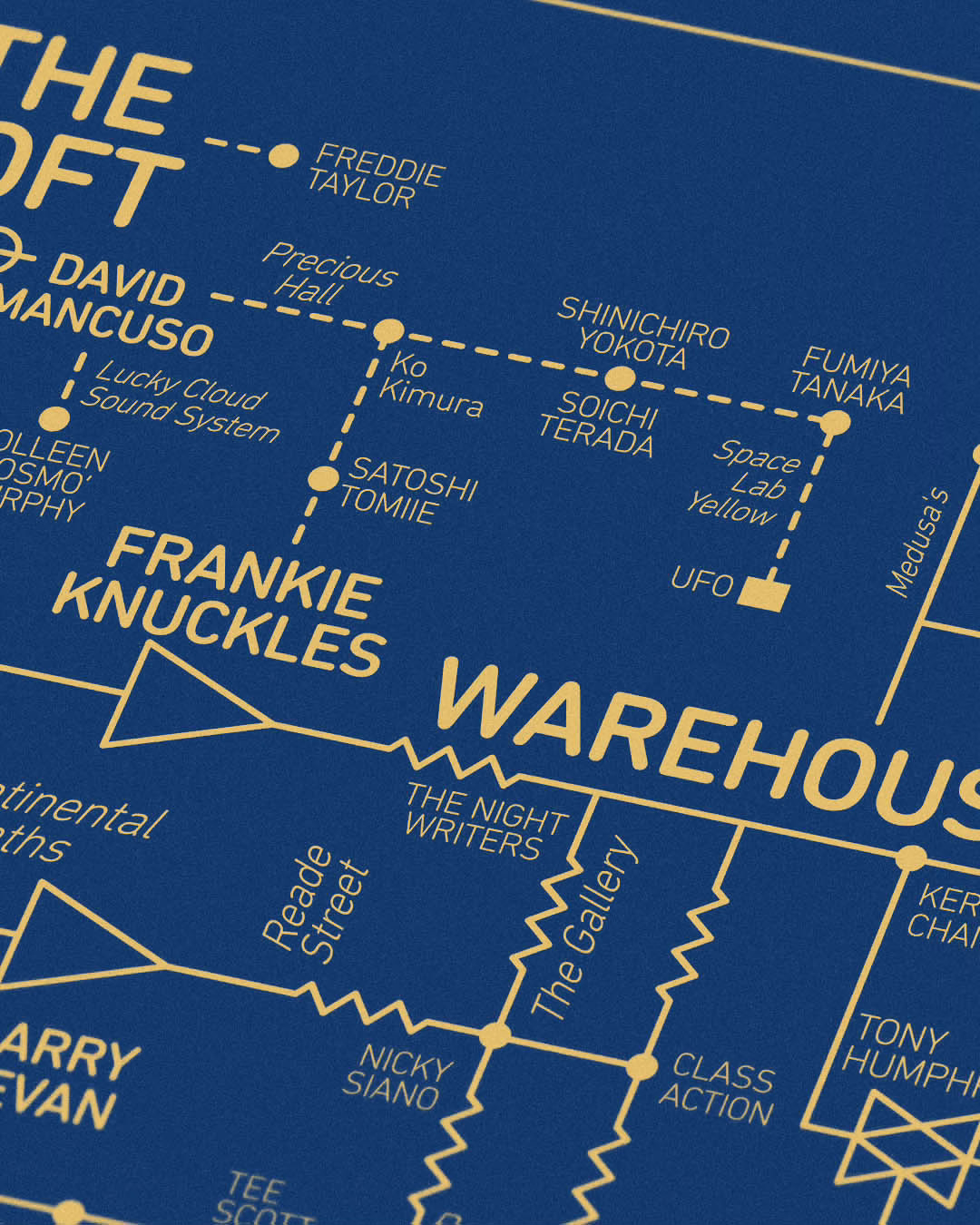
Sonny: I think the first stage of identifying gaps in the blueprint starts with our own record collections/what we’ve been listening to. I’d been digging into a lot of Shinichiro Yokota’s catalogue on Bandcamp and picked up a copy of Soichi Terada’s ‘Sounds From the Far East’ compilation whilst in Tokyo prior to starting work on the new edition of the print, so I was eager to carve out a Japanese scene.
In terms of selecting the artist, we tend to go down a rabbit hole and then come out the other end with far too many names to fit in the section, which is disappointing when having to leave people out. But it whittles its way down from there.
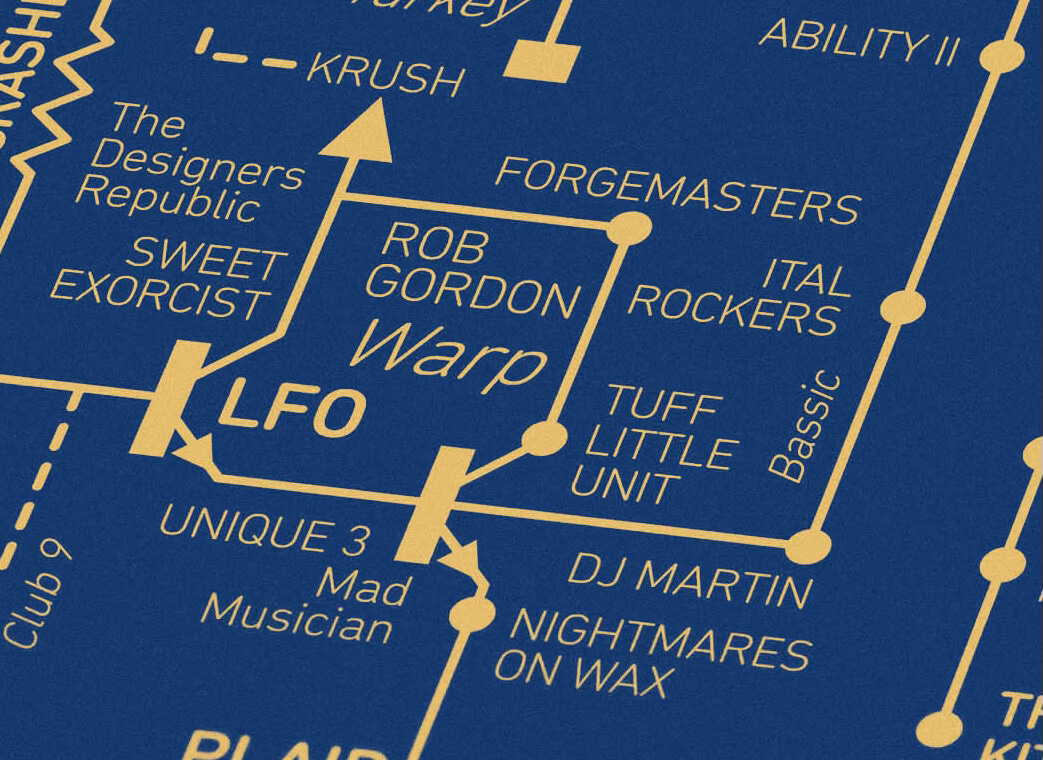
Ian: I wanted to improve a couple of the main sections. So a few of Chicago’s lesser-known clubs such as Sauer’s, Bismarck Hotel and Medusa’s have been added, as have the Music Institute’s Friday and Saturday clubs Next Generation and Back to Basics in the Detroit section. Having read Matt Annis’s book on Yorkshire bleep and bass I knew I wanted to update the Warp and Sheffield section to connect with Leeds, Bradford and Huddersfield, and to get Rob Gordon’s name central to the scene. Unforgivably we’d omitted him from earlier versions. I also felt the jungle and D&B, and broken beat could be showcased a little more and better connect with other sections. Both Sonny and I were keen to highlight the Italian scene. I’d learnt more about it via the research for the disco blueprint, and I’d been to Cocorico when I’d been interrailing in 1990 and remembered that Rimini was getting hailed as the new Ibiza in the style mags around that time. Reading about the club Baia Degli Angeli was fascinating. We tried to include as many women DJs as possible too. So, Lori Branch, Disco Toni and Stacey ‘Hotwaxx’ Hale are now added to the Chicago and Detroit scene, as are Kath McDermott, Mira Calix and Judy Griffith from the UK scene, and Cinthie and Cassy from Berlin.
As I mentioned earlier we like to include some personal micro stories.
“In this version I felt confident enough to feature The Western Star Social, which was a Jamaican social and domino club in St Pauls that hosted Bristol’s first full acid house night in late summer of 1988. We also made sure to feature those people that the scene has sadly lost in the last few years.”
Are there any scenes/nights/clubs that you’ve mapped that you wish you’d been able to attend?
Sonny: So many! My first trip to Ibiza was in 2022, so I missed Space by six years. That’s always annoyed me. But being part of any New York scene from the ‘70s through to the late ‘90s would excite me the most. Witnessing the birth of dance music and club culture as we know it, can’t really argue with that!
Ian: Clubbing in New York in the ‘70s and early ‘80s must have been amazing – especially if you got invited to Mancuso’s Loft. However I’d have loved to have gone to the Music Box in Chicago as acid house was beginning to be played by Ron Hardy. The Blackburn parties sounded pretty wild too. There was an infamous mixtape of Sasha at Shelly’s in Stoke that everyone seemed to have a copy of in 1991, which I’m sure contributed to the Sasha legend. Attending that night at Shelly’s would have made me very happy.
Ian, I know you were a regular at the Quad and were at Castlemorton too - and rave/parties/club culture existed in a very different cultural space in the past - do you think a musical movement can ever have the same kind of impact as dance music did back then? I know there were various factors at play back then but I’d be interested in getting your take on this now?
Ian: This is such a tricky question to answer, because no one wants to be that old fart banging on about how much better it was back in the day and as you say there were a variety of factors at play. For a movement like acid house there would need to be a genuinely new sound to emerge but that’s unlikely unless some new music making device is invented. I can’t see that happening, but that might be just the limit of my imagination. Dance music relies on accessible space for its community to regularly gather for any movement to develop. That’s tough these days. How many weekly club nights are there around the country anymore? Who are the up-and-coming resident DJs?
I’m not the one to be answering those questions though. Now we have social media and online communities instead, but they are shaping culture and society in ways we/I struggle to fully grasp. Perhaps something might come out of a rejection or collapse of the internet. It might already be happening.
What have been your most memorable clubbing moments?
Sonny: Seeing Kerri Chandler and Ron Trent at Knockdown Centre in New York is one that springs to mind. I remember there being a big group of break dancers at the back corner of the dancefloor. That felt really special at the time. Then the first time seeing the morning sun pierce through the Amnesia terrace. It’s a bit of a right of passage.
Ian: Dancing with mates in a tiny club in Bath that played early techno. Just a strobe and a smoke machine that we could operate ourselves from the side of the DJ booth. Alfredo at Amnesia in 1989 lived up to expectation. Anytime I was dancing in a field as the sun came up.
“The last 45 minutes of a set by John Kelly at G-Love at the Mardi Gras in Liverpool was amazing. I was there on my own, dancing with strangers to an amazing eclectic mix of music, which included a bit of ‘Bohemian Rhapsody’. It was the night after Freddie Mercury’s death was announced. It went off, as they say.”
I’d love to know what you’re listening to at the moment?
Sonny: I love US-born/Berlin-based Garrett David (protégé of the legendary Chez Damier). He’s making what I would consider the best house music out there at the minute. Hard hitting and perfect for the modern dance floors, but still honing from the classic sounds of Chicago, Detroit and New York. Then Alex Kassian is someone who we both have equal appreciation for. Love the diversity of his sound, ranging from ambient to your more typical acid house. Very happy to have gotten him on the print too.
Ian: Right now, the new Asa Tate and Musclecars releases on Rhythm Section, and a track called ‘Ceibo’ by Auntie Flo. The Payfone album has been a go to since the summer. Most things by Alex Kassian. A beautiful album by Tommy Perman and Morgan Szymanski called ‘Music for the Moon and the Trees’. I’ve listened to a lot of Roy Ayers and Max Romeo this year too (RIP).
What’s next for Dorothy?
Sonny: A busy Christmas hopefully! We’ve got a few launches in the run up. A new Northern Soul t-shirt, various prints and a new (sort of) board game which we absolutely love - definitely one for Christmas day with the family! Beyond that, Jim’s working on a new blueprint that is proving to be a bit of a mammoth, but will be ready some time next year, so keep your eyes peeled!
Find out more:
Dorothy website | Instagram | Facebook
For more club stories, you can order a copy of my book, ‘Out of Space: How UK Cities Shaped Rave Culture’ via the Velocity Press website now.